 SwC Poker Bot
Home → Anonymity & Cheating
Anonymity & cheating on SwC Poker — my read

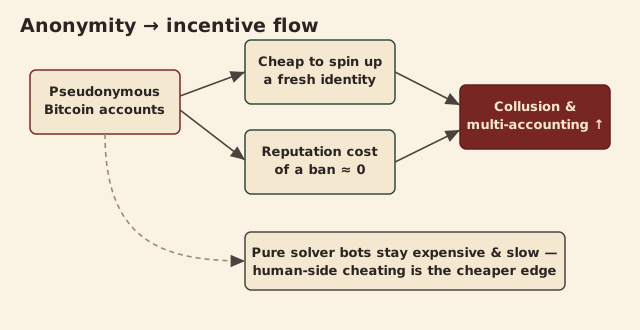
Core point: On a pseudonymous Bitcoin room like SwC Poker, the cheapest way to gain an unfair edge is almost never a fully autonomous bot. Anonymity drives the cost of a banned account to near zero, which makes collusion, multi-accounting and ghosting — all human-driven — more attractive than building, hiding and maintaining a true solver bot. Understanding that incentive shift matters more to honest players, developers and researchers than chasing the "robot" narrative.
SwC Poker (Seals with Clubs) is built on pseudonymity: a screen name funded with Bitcoin, no KYC, no real-name link. For security researchers and game developers, that is a clean natural experiment in how identity cost changes adversarial behaviour. When identity is expensive (real-name rooms), bad actors are cautious. When identity is cheap and disposable, the whole threat model tilts. This page maps that shift, then separates the human exploits from genuine solver bots.
The economics of a disposable identity
Every anti-cheat regime ultimately relies on raising the cost of getting caught. On a verified room that cost is steep: a confiscated balance tied to a real bank account, a name on a shared ban list, sometimes a permanent exclusion across sister sites. A rational cheater weighs expected gain against that very real downside.
Pseudonymity guts the downside. The maximum penalty SwC can impose on a misbehaving handle is to freeze and close it — but the person behind it keeps their off-site Bitcoin, their identity, and the ability to register again in minutes. The deterrent shrinks to "lose this one balance," which reframes cheating as a low-stakes, repeatable gamble rather than a career-ending risk. That single change is enough to reorder which exploits are worth doing.
Collusion: harder to police without identity
Collusion is two or more players cooperating at one table — soft-playing each other, sharing hole-card information, or whipsawing a victim between coordinated raises. On a real-name room, investigators link colluders through shared payment instruments, IP history, and identity graphs. On SwC, those links are mostly unavailable: two "strangers" may be one group, and the room cannot prove it from identity data alone.
That does not make collusion undetectable — it shifts detection from identity to behaviour. The signals that remain are statistical:
- Anomalous showdown patterns — players who never stack each other despite huge shared volume.
- Coordinated aggression — squeeze and re-squeeze timing that is too consistent to be independent.
- Chip-dumping signatures — value flowing one direction across many sessions.
For a developer building detection on a pseudonymous room, the lesson is to invest in behavioural and graph analytics over the hands themselves, because the identity layer that other rooms lean on simply is not there.
Multi-accounting: one operator, many seats
Multi-accounting is a single operator controlling several handles — to occupy multiple seats at one table, to abuse new-account perks, or to obscure a recognizable winning style across identities. Anonymity makes the setup trivial: each new account is just another Bitcoin-funded name with no verification gate.
| Factor | Verified real-name room | Pseudonymous (SwC-style) |
|---|---|---|
| Cost to open a new identity | High — KYC, payment, time | Near zero |
| Linkage risk between accounts | High — shared identity/payment | Low — only behaviour & metadata |
| Penalty if one account is banned | Cascades to all linked accounts | Limited to that one balance |
| Practical defense | Identity graph | Device/timing fingerprints, play-style clustering |
Again the defense moves away from "who are you" toward "how do you behave and what device/timing fingerprint do you leave." It is a harder, more statistical problem, which is precisely why pseudonymous rooms see more of this behaviour.
Ghosting vs. pure solver bots
Here is the distinction the hype usually blurs. A pure solver bot is autonomous software that reads the table state and acts on its own — no human in the loop. Ghosting keeps a human at the keyboard but feeds them real-time advice from a solver or a stronger player. Both use solver technology; only the bot is fully automated, and that difference dominates the cost and detection picture.
| Dimension | Ghosting (human + solver) | Autonomous solver bot |
|---|---|---|
| Setup cost / skill | Low — read advice, click yourself | High — vision, automation, hiding |
| Automation footprint | Almost none — human inputs | Detectable timing/mouse signatures |
| Beats the rake? | Same edge problem, but no extra cost | Thin edge often eaten by rake (see bankroll math) |
| Why anonymity helps it | Nothing to link off-table helper | Disposable account if flagged |
Because ghosting leaves a human-shaped input trace, it sidesteps the timing and mouse-movement detectors that catch autonomous bots, while delivering most of the strategic benefit. On a pseudonymous room there is also no way to link the off-table coach to the on-table account. That combination — high benefit, low footprint, unlinkable — is why ghosting, not bot-building, is the realistic threat. And as the bankroll math shows, the autonomous bot's thin edge usually does not even survive the rake, removing the main reason to take on its extra cost and risk.
Engineering detection without an identity layer
If you cannot ask "who is this person," you have to ask "what does this account do, and does it move like the others?" That reframes integrity work as a signal-engineering problem. The useful signals on a pseudonymous room fall into three families, and a serious system blends all three rather than trusting any one.
- Hand-graph signals. Treat every showdown as an edge in a graph of who-plays-whom. Pairs that share huge volume yet never stack each other, or where chips flow persistently one direction, light up as collusion or chip-dumping candidates regardless of identity.
- Timing & input signals. Humans hesitate; their decision times follow a noisy, situation-dependent distribution. Autonomous bots tend toward suspiciously regular timing and mouse paths. Ghosting, by contrast, preserves human timing — which is exactly why timing detectors miss it and graph signals have to carry the load.
- Style-clustering signals. A player's strategy fingerprint (opening ranges, bet-sizing tells, c-bet frequencies) is stickier than their screen name. Cluster accounts by play-style and you can flag one operator hiding behind several handles even when no identity data links them.
The hard part is calibration: false positives on a small room mean accusing real regulars, which kills the player pool faster than any cheater would. So thresholds have to be conservative and corroborated across signal families. This is a genuinely different engineering posture from a verified room, where the identity graph does most of the heavy lifting and behaviour is just a tiebreaker.
A comparative, working view
Step back and SwC is a useful case study in a general principle: lower the cost of identity and you change which attacks are rational. The same dynamic appears in any anonymous adversarial system — open marketplaces, pseudonymous social platforms, crypto networks. When banning an actor costs them nothing reusable, deterrence has to come from somewhere other than identity, usually from making the behaviour expensive or detectable instead.
For poker specifically, that principle predicts exactly the pattern SwC players report: not a wave of autonomous robots, but a steady undercurrent of human-driven collusion, multi-accounting and ghosting, because those are the attacks whose cost did not rise when identity got cheap. An autonomous solver bot's cost — engineering, hiding, and the rake-versus-edge problem from the bankroll math page — stayed high, so it stayed rare. The incentive map, not any moral difference between cheaters, is what shapes the threat landscape.
That is also why "ban the bots" is the wrong mental model for a room like this. The bots are the least efficient threat; the efficient threats wear a human face. Defenders who fixate on automation signatures will miss the ghost in the chair and the quiet collusion across two anonymous seats.
What this means for honest players and builders
For an honest grinder: assume the realistic risk on SwC is human-side cheating, not a faceless robot army. Watch for the behavioural tells above, keep your bankroll within the variance limits, and treat suspicious tables as a game-selection problem, not a conspiracy.
For developers and researchers: a pseudonymous Bitcoin room is a forcing function. With no identity layer to lean on, effective integrity work has to be behavioural — graph analysis of who plays whom, device and timing fingerprints, and play-style clustering across handles. Those techniques generalize well beyond poker to any anonymous adversarial system.
None of this is an endorsement of cheating, and this site sells nothing. It is a clear-eyed reading of how anonymity reshapes incentives — which is the only honest way to talk about "bots" on SwC Poker.
Independent research reference · not affiliated with Seals with Clubs / SwC Poker · educational only.