 SwC Poker Bot
Home → Bankroll Math
Bankroll math — why my numbers say an SwC bot loses to the rake

The math in one line: An autonomous bot at SwC low stakes might net 1–2 bb/100 after the room's roughly 5% capped rake, while the standard deviation of its results is around 90 bb/100. That is an edge-to-noise ratio so thin that variance — not skill — decides whether any given month is a win, and the long-run ROI on bankroll lands in the low single digits, below the cost and detection risk of running it.
People imagine a bot as a money printer. The numbers say otherwise. Poker results are dominated by variance, and a bot's edge is bounded by two things it cannot escape: the rake the room takes from every pot, and the field quality — how many of the opponents are other good regs (or other bots) rather than recreational "fish." On SwC, a small Bitcoin room with a reg-heavy player pool, both of those work against you.
This page models the whole thing explicitly so you can see where the edge goes. All figures are in big blinds ("bb"), the standard unit so the math holds across stakes; "bb/100" means big blinds won per 100 hands.
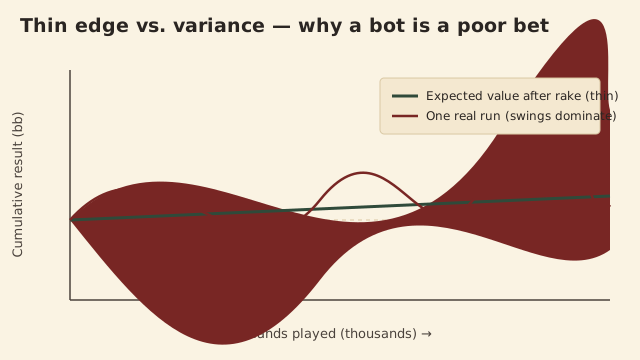
Step 1 — where the win rate actually lands
Start from the gross edge. A genuinely strong low-stakes bot might win 3 bb/100 before rake against a soft field. But SwC's rake — broadly a 5% take capped per pot — costs an active player on the order of 1.5 bb/100 at these stakes. As the field stiffens (more regs, fewer fish), the gross edge shrinks while the rake stays fixed, so the net collapses fast.
| Field | Gross edge (bb/100) | Rake (bb/100) | Net win rate (bb/100) |
|---|---|---|---|
| Soft (many fish) | 3.0 | 1.5 | +1.5 |
| Mixed | 2.0 | 1.5 | +0.5 |
| Reg-heavy (typical SwC) | 1.2 | 1.5 | −0.3 |
| Bot vs bot | 0.5 | 1.5 | −1.0 |
In the two most realistic SwC scenarios the net win rate is at or below zero after rake. The bot does not have to lose to humans — it loses to the house's cut. That is the first reason an SwC bot is a poor bet.
How the rake quietly sets the ceiling
It is worth dwelling on the rake because it is the part players consistently under-count. A "5% capped" structure means the room takes 5% of each pot up to a fixed ceiling. At low stakes most pots are small enough that you pay close to the full 5%, so the rake behaves like a flat tax on volume. The more hands a bot plays — and a bot's whole premise is high volume — the more total rake it pays in absolute terms, even though the percentage per pot is unchanged.
Crucially, the rake is charged on pots you win, not on your net profit. A grinder who wins a 200-bb pot hands back roughly 10 bb of it before the chips ever hit their stack. Over hundreds of thousands of hands that drag is enormous, and it falls hardest on exactly the tight-aggressive, high-volume style a solver bot plays. In other words, the rake is not a fixed cost you can engineer around; it scales with the very behaviour that makes the bot a bot.
This is also why the gross edge in Table 1 erodes faster than people expect. A bot does not get to keep its raw strategic advantage — it keeps the advantage minus a tax that grows with its activity. On a small Bitcoin room the player pool cannot subsidise that tax with a flood of recreational losers, because there simply are not that many of them, so the rake comes proportionally more out of the regulars' (and the bot's) pockets.
Step 2 — variance dwarfs the edge
Even where the net win rate is positive, it is tiny next to the swings. A 6-max no-limit game has a standard deviation around 90 bb/100. Compare that to a +1.5 bb/100 edge: the noise is roughly 60× the signal over 100 hands. You need an enormous sample before the edge reliably shows through.
| Hands | Expected result (bb) | Std dev of result (bb) | Chance of being in the red |
|---|---|---|---|
| 1,000 | +15 | ±285 | ≈ 48% |
| 10,000 | +150 | ±900 | ≈ 43% |
| 100,000 | +1,500 | ±2,850 | ≈ 30% |
| 1,000,000 | +15,000 | ±9,000 | ≈ 5% |
You need on the order of a million hands — months of multi-tabling — before a 1.5 bb/100 winner is even 95% likely to be ahead. On a small room like SwC, simply finding enough live tables to play that volume is itself a constraint, and the more you grind the more the field adapts to a recognizable style.
Step 3 — downswing risk and required bankroll
Variance is not just an abstraction; it dictates how much capital you must lock up and how deep the drawdowns get. Risk-of-ruin math ties the needed bankroll to the ratio of variance to edge. With a razor-thin edge that ratio explodes.
| Net win rate (bb/100) | Required bankroll (buy-ins) | Typical worst downswing |
|---|---|---|
| +3.0 (dream field) | ≈ 27 buy-ins | 15–20 buy-ins |
| +1.5 (good field) | ≈ 54 buy-ins | 25–35 buy-ins |
| +0.5 (mixed field) | ≈ 160 buy-ins | 50+ buy-ins |
| ≤ 0 (reg-heavy) | infinite — ruin is certain | terminal |
At the realistic +0.5 bb/100 you must keep ~160 buy-ins in play to survive normal variance. That is a large, idle Bitcoin balance exposed to price swings, room risk, and confiscation if the bot is ever flagged — all to chase a sub-1% monthly edge.
Step 4 — ROI on bankroll, the bottom line
Convert the win rate into return on the capital you must hold. Assume a steady grind of 30,000 hands per month (serious multi-tabling). ROI = (net bb/100 × hands ÷ 100) ÷ (bankroll in bb).
| Net win rate (bb/100) | Monthly profit (bb) | Bankroll held (bb) | Monthly ROI |
|---|---|---|---|
| +3.0 | 900 | 2,700 | ≈ 33% |
| +1.5 | 450 | 5,400 | ≈ 8.3% |
| +0.5 | 150 | 16,000 | ≈ 0.9% |
| ≤ 0 | ≤ 0 | — | negative |
The headline +33% only exists in a dream soft field that does not persist on SwC. In the realistic mixed/reg-heavy band the ROI is roughly 1% a month or less — and that is the gross figure before you subtract development time, server and proxy costs, Bitcoin volatility on the locked bankroll, and the standing risk that a single detection event zeroes the whole balance. Risk-adjusted, it is a losing trade.
Step 5 — the costs the rake table never shows
Everything above treats the bot as if running it were free. It is not. A pseudonymous Bitcoin room layers on costs that do not exist on a fiat real-name site, and they all come out of that already-thin ROI.
- Bankroll volatility. The 160-buy-in bankroll from Table 3 is held in Bitcoin. A 20% BTC drawdown in a month can erase a year of grinding edge before a single hand is dealt — your "risk-free" capital is anything but.
- Infrastructure. Autonomous play needs a hidden client, screen-scraping or API hooks, a controlled environment, and often proxies to avoid linking accounts. That is real engineering time plus recurring server cost.
- Maintenance decay. Any client update, table-layout change, or new anti-cheat heuristic can break the bot. Unlike a strategy, software rots; the edge has a maintenance bill attached.
- Tail risk of confiscation. A single detection event freezes the whole balance. Expressed as expected value, even a small monthly detection probability times a large bankroll is a brutal negative term.
Fold those in and the realistic +0.5 to +1.5 bb/100 band — already a 1–8% gross monthly ROI — turns net-negative for most operators once volatility and tail risk are priced honestly. The dream +33% line was never the realistic case; the realistic case is a leveraged bet on a thin edge with a non-trivial chance of going to zero.
A quick sanity check against alternatives
If the goal is simply to grow Bitcoin, almost any lower-variance use of the same capital dominates a sub-1% monthly edge that can be wiped out by one ban. The only scenario where the bot math looks attractive is the soft-field fantasy, and soft fields are precisely what a small, mature, reg-heavy room like SwC does not offer. That mismatch — capable but not profitable, profitable only against fields that do not exist here — is the whole story in one sentence.
Why the math, not the hype, is the point
Strip away the marketing and an "SwC poker bot" is a low-single-digit ROI instrument with high variance, large capital lockup, and tail risk of total loss. The thin edge survives only against fields that the room does not actually have, and the moment the field tightens — which on a small reg-heavy Bitcoin room it already has — the net edge crosses zero and the required bankroll goes to infinity.
That is exactly why the smarter (and unfortunately more common) plays on a pseudonymous site are human: collusion, multi-accounting and ghosting, which sidestep the rake-versus-variance trap entirely. The anonymity & cheating page works through that incentive shift.
Independent research reference · not affiliated with Seals with Clubs / SwC Poker · no bots sold here.